
The Burning Heart

“Did not our heart burn within us?”—Luke 24:32.

We need to learn the secret of the burning heart. Suddenly Jesus appears to us, the fires are kindled, we have wonderful visions, then we have to learn to keep the secret of the burning heart that will go through anything. It is the dull, bald, dreary, commonplace day, with commonplace duties and people, that kills the burning heart unless we have learned the secret of abiding in Jesus.

Much of our distress as Christians comes not because of sin, but because we are ignorant of the laws of our own nature. For instance, the only test as to whether we ought to allow an emotion to have its way is to see what the outcome of the emotion will be, push it to its logical conclusion, and if the outcome is something God would condemn, allow it no more to have its way. But if it be an emotion kindled by the Spirit of God and you do not let that emotion have its right issue in your life, it will react on a lower level. That is the way sentimentalities are made.

The higher the emotion is, the deeper the degradation will be, if it is not worked out on its proper level. If the Spirit of God has stirred you, make as many things inevitable as possible, let the consequences be what they will.

We cannot stay on the mount of transfiguration, but we must obey the light we received there; we must act it out. When God gives a vision, transact business on that line, no matter what it costs.


Spiritual Warfare

“And let the peace (soul harmony which comes) from Christ rule (act as umpire continually) in your hearts [deciding and settling with finality all questions that arise in your minds, in that peaceful state]. . .And be thankful (appreciative), [giving praise to God always].”—Colossians 3:15.

You are waging spiritual warfare when you give radical praise to God in the midst of your need. When you are thankful to God for all He has done and is doing, you are demonstrating your victory over the enemy. When you hold your peace in the midst of the storm, you are warring with spiritual weapons—“(For the weapons of our warfare are not carnal, but mighty through God to the pulling down of strong holds;) Casting down imaginations, and every high thing that exalteth itself against the knowledge of God, and bringing into captivity every thought to the obedience of Christ;”—2 Corinthians 10:4-5.

Jesus said, “Peace I leave with you; My [own] peace I now give and bequeath to you. . .[Stop allowing yourselves to be agitated and disturbed; and do not permit yourselves to be fearful and intimidated and cowardly and unsettled]”—John 14:27. Jesus has given you peace! Put it on, and wear it everywhere you go.

Judgment of the Abyss of Love

“For the time is come that judgment must begin at the house of God.”—I Peter 4:17.

The Christian must never forget that Salvation is God’s thought, not man’s; therefore it is an unfathomable abyss.

Salvation is the great thought of God, not an experience. Experience is only a gateway by which Salvation comes into our conscious life. Never preach or teach the experience. Preach and teach the great thought of God behind. When we preach or teach we are not proclaiming how man can be saved from hell and be made moral and pure; WE ARE CONVEYING GOOD NEWS ABOUT GOD!

In the teachings of Jesus Christ the element of judgment is always brought out, it is a sign of God’s love. Never sympathize with a soul who finds it difficult to get to God, God is not to blame.

It is not for us to find out the reason why it is difficult, but so to present the truth of God that the Spirit of God will show what is wrong. The great acid test in preaching and teaching is that it brings EVERYONE INTO JUDGMENT. The Spirit of God locates each one to himself.

If Jesus ever gave us a command He could not enable us to fulfill, He would be a liar; and if we make our inability a barrier to obedience, it means we are telling God there is something He has not taken into account. Every element of self-reliance must be slain by the power of God. Complete weakness and dependence will always be the occasion for the Spirit of God to manifest His power.

The Way of Abraham

“. . .He went out not knowing whither he went.”—Hebrews 11:8

In the Old Testament, a personal relationship with God showed itself in separation, and this is symbolized in the life of Abraham by his separation from his country and from his kin.  Today the separation is more of a mental and moral separation from the way that those who are dearest to us look at things, that is, if they do not have a personal relationship with God.  Jesus Christ emphasized this [see Luke 14:26].

Faith never knows where it is being led, but it loves and knows the One Who is leading.  It is a life of FAITH, not of intellect and reason, but a life of knowing Who makes us “go.”  The root of faith is the knowledge of a Person, and one of the biggest snares is the idea that God is sure to lead us to success.

The final stage in the life of faith is attainment of character.  There are many passing transfigurations of character; when we pray we feel the blessing of God enwrapping us and for the time being we are changed, then we get back to the ordinary days and ways and the glory vanishes.  The life of faith is not a life of mounting up with wings, but a life of walking and not fainting.  It is not a question of sanctification; but of something infinitely further on than sanctification, of faith that has been tried and proved and has stood the test.  Abraham is not a type of sanctification, but a type of the life of faith, a tried faith built on a real God.

The Never Failing God

“For He hath said, I will never leave thee, nor forsake thee.”—Hebrews 8:5.

What line does my thought take?  Does it turn to what God says or to what I fear?  Am I learning to say not what God says, but to say something after I have heard what He says?  “He hath said, I will never leave thee, nor forsake thee. So that we may boldly say, The Lord is my helper, and I will not fear what man shall do unto me.”
“I will in no wise fail thee”—not for all my sin and selfishness and stubbornness and waywardness.  Have I really let God say to me that He will never fail me?  If I have listened to this say-so of God’s, then let me listen again.
“Neither will I in any wise forsake thee.” Sometimes it is not difficulty that makes me think God will forsake me, but drudgery.  There is no Hill Difficulty to climb, no vision given, nothing wonderful or beautiful, just the commonplace day in and day out – can I hear God’s say-so in these things?
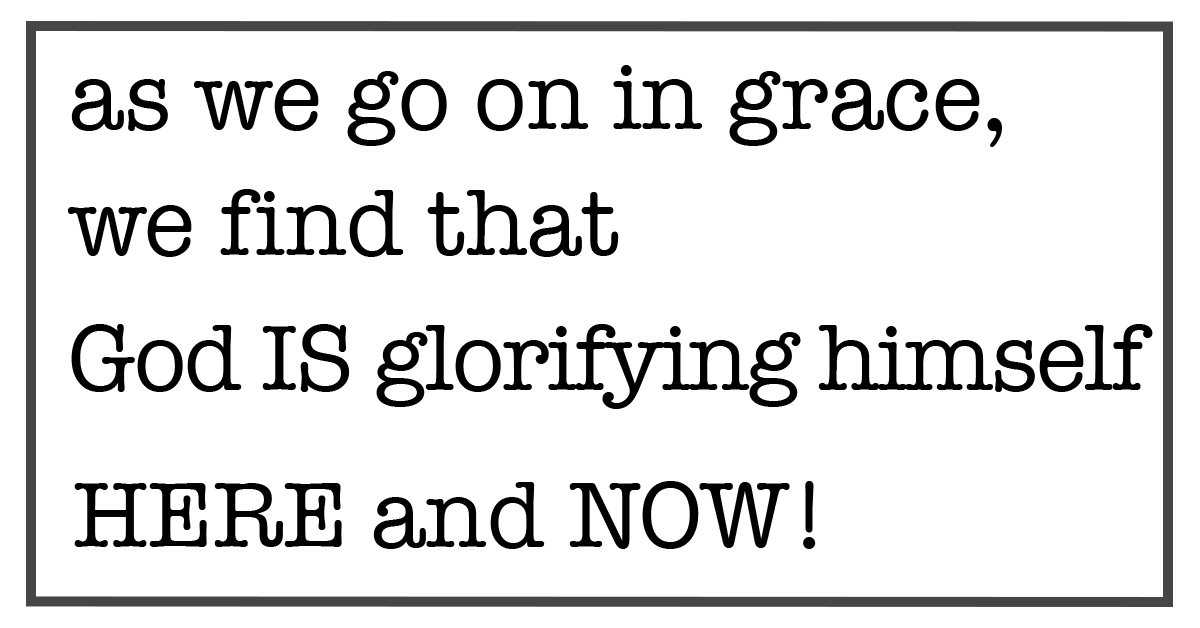
We have the idea that God is going to do some exceptional thing, that He is preparing and fitting us for some extraordinary thing bye and bye, but as we go on in grace we find that God is glorifying Himself here and now, in the present minute.  If we have God’s say-so behind us, the most amazing strength comes, and we learn not to sin in the ordinary days and ways.